Phase Transition at Fifty-One
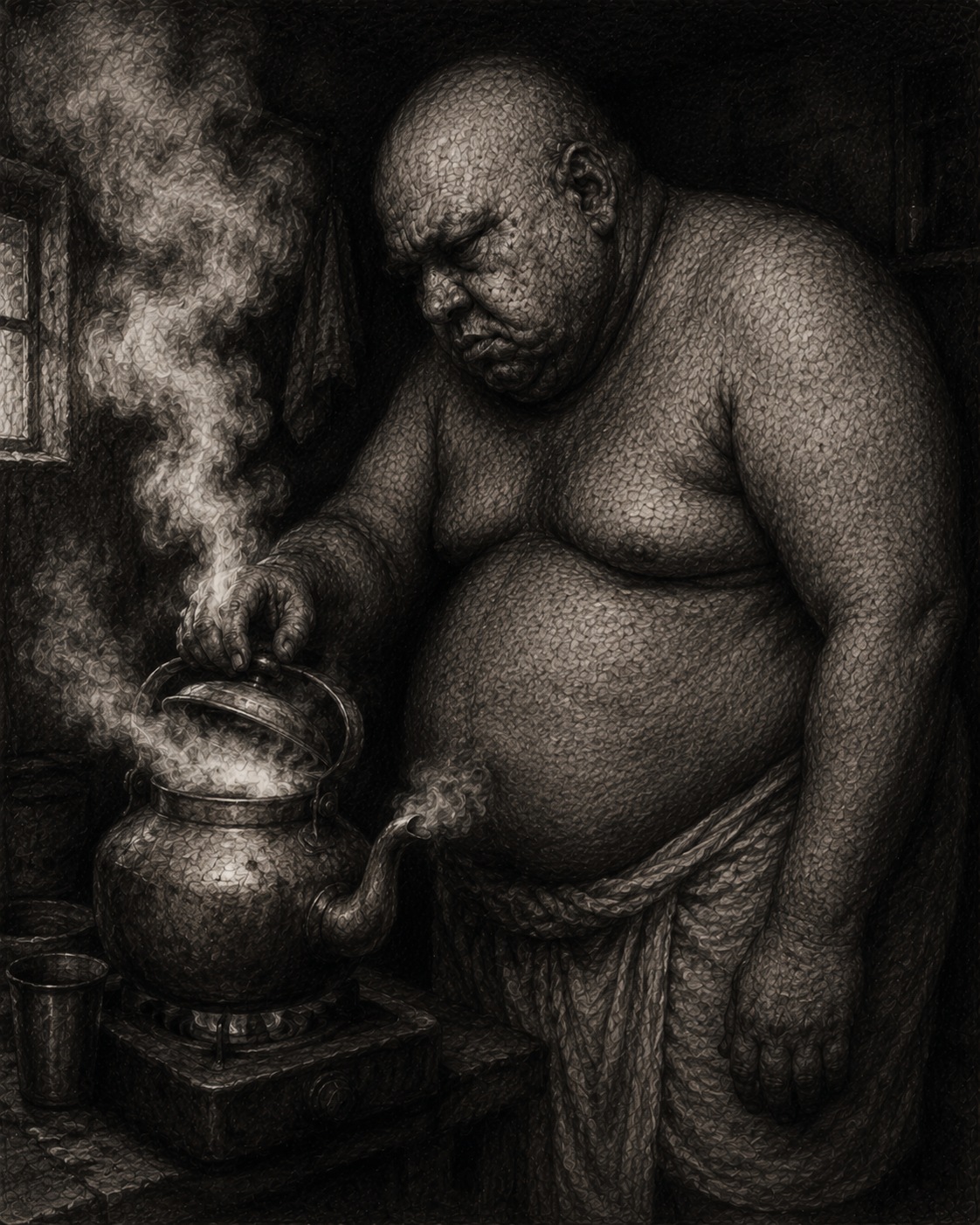
AC: Air Conditioner, the household machine that cools the room by moving heat elsewhere and then announces its labor with a compressor sound that can interrupt a man’s private ruin.
HR: Human Resources, the office function that claims to manage people but usually manages documents, suspicion, and polite rejection.
NRI: Non-Resident Indian, an Indian living outside India, often treated as a portable wallet with nostalgia.
USB: Universal Serial Bus, the common plug-and-cable standard that connects devices and somehow still fails at the exact moment civilization needs it.
My tea pan knows before I do.
It begins with a shiver. Not a whistle yet. Not drama. Just cheap steel trembling on the hot plate, a little domestic warning from the kitchen, while the water gathers tiny bubbles at the bottom like clerks whispering before a strike. Outside, some pigeon is making its usual throat noise, as if evolution reached the bird kingdom and then lost interest. The AC compressor starts with a tired cough. Somewhere in the building a pump groans and pulls water upward like a reluctant municipal employee.
And there I am, in the shanty edge of Calcutta, middle-aged, underdressed, waiting for tea and watching physics behave better than my life.
Water does not become steam gradually forever.
That is the whole insult.
You heat it and heat it, and for a while it remains water. Hotter water. More agitated water. Water with internal disturbance and no visible promotion. A very familiar condition to any Bengali man who has collected degrees, crossed oceans, worked in America, returned to India, tried to remain honest, failed to lie with professional smoothness, and then discovered that civilization rewards many things, but decency is not always one of them.
Then one day the water crosses a threshold.
It changes state.
Liquid becomes vapor.
The old arrangement can no longer hold.
No motivational speaker is required. No sandalwood-scented guru. No abundance journal. No NRI seminar where some man in a blazer explains success while charging people the price of a month’s groceries. The water changes because enough energy has entered the system.
This is where the question starts biting.
Can a life do that?
Or did I miss my boiling point somewhere between airports, job gaps, unpaid invoices, bad sleep, dental pain, psychiatric medicines, and the slow bureaucratic burial of hope?
At twenty-five, failure is almost decorative. It has hair. It has background music. It can still tell people, “I am figuring things out.”
At thirty, failure becomes worrying.
At forty, it becomes biography.
At fifty-one, it becomes geology.
It stops being something that happened. It becomes the ground under your feet. Earlier promise lies buried in layers. Degree, job, foreign life, reputation, old competence, all pressed down like fossils under a rented room where the ceiling fan knows too much.
Young failure is rubber. Middle-aged failure is clay left in the sun.
Nobody tells you this, because most advice is written by people with backup money, family property, supportive spouses, or the moral imagination of a plastic bucket.
When you are twenty-eight and unemployed, people say, “Something will happen.”
When you are fifty-one and semi-employed, or consulting like a ghost wearing a formal shirt, people say very little. That silence is not kindness. It is classification. At twenty-eight, a gap is a gap. At fifty-one, a gap becomes a label.
Not current.
Not energetic.
Not reliable.
Not normal.
Not safe to recommend.
Not one of us.
Material rejected.
India is extremely talented at this. Give this country one living human being and it can turn him into a file, a rumor, a warning, a family example, and a WhatsApp sermon before the tea has cooled.
Then the world says: reinvent yourself.
Lovely word, reinvention. Smooth, imported, well-lit. It belongs to people who have savings, dental insurance, quiet rooms, and curtains that were bought as a choice rather than accepted from a previous tenant.
A rich man reinvents himself by taking six months off.
A poor man reinvents himself by using the same towel one more day.
A lonely man reinvents himself by changing which side of the bed he collapses on.
A depressed man reinvents himself by brushing properly in the morning and treating it like the Green Revolution.
This sounds comic only if you are not the toothbrush.
There is a phrase in physics I have always liked: latent heat.
Latent heat is energy absorbed during a change of state without the temperature visibly changing. You keep heating the water. The thermometer seems stubborn. Nothing dramatic appears to happen. But inside, bonds are loosening. Arrangements are breaking. Molecules are preparing to escape the old form.
A beautiful idea.
Also a dangerous one.
For years I told myself my suffering was latent heat. The humiliation, the insomnia, the money fear, the loneliness, the rage, the long afternoons, the work that almost came and then vanished, the careful emails sent into silence, the mornings when even bathing looked like a civil engineering project — surely all that was doing something inside me. Surely the bonds were breaking. Surely a new state was preparing.
But here is the catch.
Not all heat transforms.
Some heat damages.
Every Bengali learns this from rice.
There is a good moment in rice cooking. Water, grain, steam, patience. A small civilization inside a cooker. Then comes the correct instant, soft rice, modest dignity, lunch still possible. After that, if you forget, the bottom begins to catch. First a little. Then brown. Then hard. Then smoke. Finally that smell rises, the ancient household smell of failure: burnt starch, metal, and accusation.
A life can burn like that.
People love transformation stories because they stop the film before the smoke.
They show the man before and after. Never the vessel. Never the electricity bill. Never the cracked tooth. Never the afternoon when he sat with the phone in his hand and could not reply to one simple message because the mind had become a locked almirah with a missing key.
That is the part that frightens me.
Not death. Death at least has manners. It ends the paragraph.
I am talking about being post-alive. A corpse dragging on, but with chores. Dreams dead. Hopes dead. But phone recharge pending. Rice pending. Toothache pending. Mother aging. Money due. Message unanswered. One more day standing at the door like a man from the electricity board.
Hope at this age is not a bird.
Hope is that little dry grain of rice stuck to the side of the cooker, curled and stubborn, pretending it once belonged to a meal.
Loneliness changes too.
In youth, loneliness is weather. It arrives, makes a scene, leaves.
After fifty, it becomes climate.
You do not say, “I am lonely today.” You realize the room has pressure. The curtain moves in it. The bedsheet smells of it. Tea cools inside it. The mobile phone, that glowing monument to world connection, sits beside you like a small priest of no messages.
And the city goes on.
Someone sells eggs downstairs. Someone argues about change. Someone’s pressure cooker screams. A scooter coughs past with two schoolchildren and one impossible bag. The news on YouTube is shouting about another national crisis in the same tone used to sell floor cleaner. The country is always either rising, collapsing, transforming, or being blessed by a ribbon-cutting ceremony. Meanwhile, in one small room, a man is trying to decide whether boiling water is mocking him personally.
It probably is not.
This is where education becomes a nuisance.
If I were properly foolish, I could outsource the whole matter. Planets. Ancestors. Karma. Some guru with an excellent beard and a payment QR code. But I have read too much. I know enough physics to know matter changes under conditions. I know enough biology to know the brain is not a soul but a wet electrical bazaar. I know enough history to know that societies have always discarded inconvenient people with impressive neatness.
Knowing does not save you.
It merely removes the cheaper chairs in the waiting room.
The tea rises suddenly. Milk climbs the pan in a pale rebellion. I lower the heat, because even despair should not require mopping.
So here is the real question.
Can a man change state after society has already labeled the material?
Society is not a neutral laboratory. It does not say, “Let us see what happens under altered pressure.” Society says, “This one is already filed: aging, unstable, financially weak, socially awkward, not useful, not marriageable, not impressive, not fresh stock.”
Once labeled, the material is handled differently.
A young man with no direction is raw potential.
An older man with no direction is a cautionary tale.
A young depressed man is sensitive.
An older depressed man is difficult.
A young angry man is passionate.
An older angry man is unsafe.
A young poor man is struggling.
An older poor man is evidence, and every mediocre person loves evidence that intelligence does not matter.
Still, physics keeps a tiny back door open.
Pressure matters.
Containers matter.
Timing matters.
A small impurity can change the behavior of a whole liquid. A scratch in a glass can start crystallization. Carbon can become graphite or diamond depending on arrangement and pressure, though carbon has the advantage of not receiving phone calls from creditors.
This is not hope.
I distrust hope. Hope has behaved badly in my house. It arrives wearing perfume, speaks grandly, eats the biscuits, and leaves without paying rent.
Possibility is different.
Possibility is not cheerful. It does not ask you to manifest. It does not do yoga on Instagram. Possibility is a crack in a locked bathroom door when your stomach has already hired a lawyer. Not glory. Not rescue. Just a crack.
Maybe at fifty-one, the phase transition is not water into steam.
Maybe that fantasy belongs to the young, the funded, the desired, the people whose HR profiles look as if they were laminated by angels.
Maybe at fifty-one the change is smaller.
Milk to curd.
Rice to kanji.
Meat to broth.
Man to stubbornness.
Fermentation is not glamorous. It is controlled rot. But it makes food out of perishability. That is the unpleasant miracle. A mango rots and becomes garbage. Milk sours and becomes curd. Same decline, different handling. Same vulnerability, different vessel.
That may be the only honest lesson left.
I do not feel reborn.
I do not feel inspired.
I do not feel ready.
I feel like tea leaves boiled twice, drained of color, still staining the water out of spite.
The biscuits have gone soft in the humidity and bend sadly when dipped, like old revolutionaries entering coalition politics. The cup is too hot to hold. My body wants bed. My mind wants prosecution. My bladder, punctual as a tax notice, wants attention.
Outside, Calcutta continues its great public experiment of keeping human beings just below boiling and well above comfort.
I drink the tea anyway.
Apparently even a dragging corpse must hydrate.